I do not use the word "abductees" when discussing those who claim to have been abducted by alien beings. It implies an objective conclusion that, on the basis of the available evidence, simply cannot be proved.
This does not mean that some of these people did not have a genuine experience with something that our science cannot explain.
Accordingly, I use the term "experiencers."
This is the term that I also use, with the utmost respect, to describe people who claim to have had direct contact with the Divine. Again, an experience that science is unable to explain.
Take, for example, the "experience" of Atlantic Canada's most important religious leader, Henry Alline (painting below), a man whose life and writings I have studied extensively. In 1776, the 28 year old Alline underwent a spiritual conversion that changed his life. It led him to launch a "New Light" Christian ministry that was nothing short of revolutionary. By the time of his death eight short years later (from the tuberculosis with had plagued him throughout much of his time as an evangelist), his "Great Awakening" had changed society in Atlantic Canada (and, to a somewhat lesser extent, New England) in ways that are still felt today.
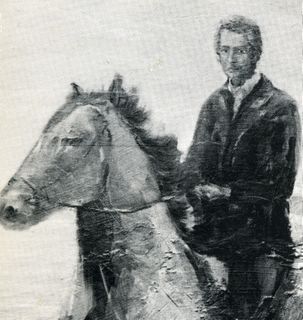
It is his description of his "experience with the Divine," however, that is most intriguing.
He wrote in his Journal:
"My whole soul, that was a few minutes ago groaning under mountains of death, wading through storms of sorrow, racked with distressing fears, and crying to an unknown God for help, was now filled with immortal love, soaring on the wings of faith, freed from the chains of death and darkness, and crying out my Lord and my God; thou art my rock and my fortress, my shield and my high tower, my life, my joy, my present and everlasting portion."
The sudden, transforming power of Alline's experience - his spiritual regeneration, as he termed it - led him to declare that he had been "ravished with a divine ecstasy" and wrapped up in God." Over and over in his sermons, pamphlets and hymns in the years that followed, he referred to being "married" to his Saviour. He was overwhelmed by a Divine Love, a spiritual rapture, which I simply cannot comprehend, but accept as sincere - and real.
Time and space stopped for him, seemingly literally. God, he wrote, lived in "One Eternal Now" and that the "redeemed" inhabited the same place - in a sense, meaning that they could transcend temporal boundaries, and travel through time. For the truly converted there was no sense of "Time, and Space, and successive Periods." Salvation and Damnation, Alline wrote in
Two Mites:
"originate here at your own Door; for with God there never was any such Thing, as before or after, Millions of Ages, before time began, and as many more, after Time is at a Period, being the very same instant; consider neither Time past nor Time to come, but one Eternal NOW; consider that with God there is neither Succession nor Progress; but that with Him the Moment He said let us make Man, and the Sound of the last Trumpet, is the very same instant, and your death as much first as your Birth... with God all things are NOW... as the Center of a Ring, which is as near the one side as the other."
Historian George Rawlyk put this amazing experience into perspective in
New Light Letters and Songs (Wolfville, Nova Scotia: Lancelot Press, 1983):
"Conversion, therefore, was not only the means whereby those who had freely chosen the 'Electing Love of God' were able, in a spiritual sense, to return to paradise but also the God-given instrument of telescoping time into the 'Eternal Now.' Regeneration was the process which destroyed artificial time and space and astonishingly transformed, for each individual, the mundane - what Alline described as the world of 'Turnips, Cabbages and Potatoes' - into the cosmic and heavenly - 'the Eternity you once, was, and knew.'"
Michio Kaku might take note.
So, you may ask, how does this relate to ufology?
I'm not sure, exactly.
It could be simply that the world is full of strange things that we cannot explain, in many different, unrelated areas.
But I sense it might be more than that - something bigger, more profound. That there are links... that there are people who experience things that are "otherworldly." These experiences may be tailored to a certain era - Alline, accordingly, believed his was spiritual, because that was the common reference point of his time. People in our technological era may use different language, and even tell different stories, to describe what is, essentially, the same thing - an "experience" with an intelligence that we cannot comprehend.
A final note. Simeon Perkins, a prosperous merchant in Liverpool, Nova Scotia, and contemporary of Alline, kept a journal throughout his life. He eventually broke with Alline over theological differences (the devil is always, it seems, in the - very human - details), but initially he was favourably impressed. After attending a sermon by Alline, he wrote, "This is a wonderful day and Evening. Never did I behold such an Appearance of the Spirit of God moving upon the people."
What makes Perkins interesting is that he also recorded Canada's first UFO sighting. In 1796, he wrote:
"A strange story comes from the Bay of Fundy, that ships have been seen in the air. Mr. Darrow is lately come from there by land. I inquired of him. He stated that they were said to be seen at New Minas, near Mr. Ratchford's, by a girl about sunrise. The girl cried out and two men, who were in the house, came out and saw them. There were 15 ships and a man forward with his hands stretched out. They made to the eastward. They were so near people saw their sides and ports. The story did not obtain universal credit, but some people believed it."
The Bay of Fundy - the same general area where Henry Alline had met his God twenty years earlier, and, forever changed by that experience, went on to make history.
Time past, time present, time future.
To paraphrase the Bard, "there are more things in heaven and earth, Ufology, than are dreamt of in your philosophy."
Paul Kimball